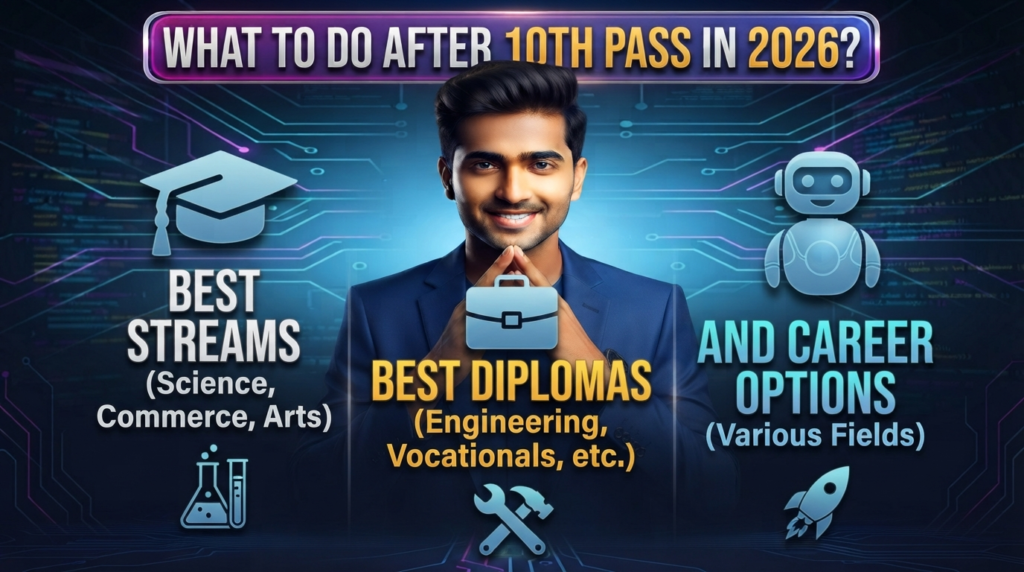
Passing Class 10 is one of the first important milestones in a student’s educational journey. After completing the 10th standard, students must make an important decision about their future education and career.
Some students want to become engineers, doctors, software developers, business owners, or government employees. Others want to learn practical skills and start working as early as possible.
However, many students and parents are confused about what to do after 10th. Should you choose Science, Commerce, or Arts? Is a diploma better than 11th and 12th? Can you learn computer programming, artificial intelligence, or other technical skills after Class 10?
The good news is that there are several educational and career options available after passing Class 10 in India.
In this article, we will explore the best courses after 10th in 2026, different academic streams, diploma programmes, ITI courses, future technology skills, and career opportunities.
Why Is Choosing the Right Education After 10th Important?
Class 10 is an important stage because students begin moving towards more specialised education.
The subjects you choose after 10th can influence your future degree options and professional opportunities.
For example, students interested in engineering or medical education generally need to select the appropriate Science subjects in Class 11 and 12. Students interested in accounting and business may prefer Commerce, while those interested in humanities, law, psychology, or creative subjects may consider Arts.
However, there is no universally best stream.
The right choice depends on your interests, strengths, financial circumstances, and long-term career goals.
In 2026, students should also consider emerging areas such as Artificial Intelligence, Data Science, Cybersecurity, Software Development, Robotics, and Digital Business.
1. Choose Science After 10th
Science is a popular option for students interested in technology, engineering, medicine, research, and scientific subjects.
After passing Class 10, students can generally choose Science in Class 11 and 12.
Science is commonly divided into two combinations.
PCM – Physics, Chemistry and Mathematics
PCM is suitable for students interested in mathematics, engineering, computers, and technical fields.
Common subjects include:
- Physics
- Chemistry
- Mathematics
- English
- Optional subjects depending on the school
After completing 12th with the required subjects and eligibility, students can explore:
- B.Tech Computer Science
- B.Tech Artificial Intelligence
- B.Tech Mechanical Engineering
- B.Tech Civil Engineering
- B.Tech Electrical Engineering
- B.Tech Electronics
- B.Sc Computer Science
- B.Sc Mathematics
- B.Sc Physics
- Architecture
Students interested in engineering can prepare for entrance examinations such as JEE Main and other applicable admission tests.
PCB – Physics, Chemistry and Biology
PCB is suitable for students interested in healthcare, medicine, biology, and life sciences.
Common subjects include:
- Physics
- Chemistry
- Biology
- English
- Optional subjects depending on the school
After completing 12th, students may consider:
- MBBS
- BDS
- BAMS
- BHMS
- B.Sc Nursing
- Bachelor of Physiotherapy
- B.Pharm
- Biotechnology
- Microbiology
- Medical Laboratory Technology
Medical degree admission requirements vary. For MBBS and several other medical programmes in India, NEET-UG is an important entrance examination.
PCMB – Physics, Chemistry, Mathematics and Biology
Some schools offer PCMB, which includes both Mathematics and Biology.
This combination can provide flexibility for students interested in both engineering and biological sciences.
However, it also involves a heavier academic workload. Students should select it only if they are comfortable studying all four subjects.
2. Choose Commerce After 10th
Commerce is another popular option for students interested in business, accounting, finance, banking, and management.
Students who choose Commerce in Class 11 and 12 generally study subjects such as:
- Accountancy
- Business Studies
- Economics
- English
- Mathematics or Applied Mathematics, depending on the school
- Optional subjects
Commerce can be a good choice for students interested in understanding how businesses, financial systems, and markets operate.
Courses Available After 12th Commerce
After completing Class 12, Commerce students can explore:
- B.Com
- BBA
- Bachelor of Economics
- Bachelor of Management Studies
- Chartered Accountancy
- Company Secretary
- Cost and Management Accountancy
- Banking and Finance
- Business Analytics
- Financial Technology
Students can also learn Excel, accounting software, financial analysis, digital marketing, and AI tools alongside their education.
3. Choose Arts or Humanities After 10th
Arts is a suitable option for students interested in social sciences, communication, history, psychology, law, public administration, and creative subjects.
Students can choose subjects according to the options available at their school.
Common subjects include:
- History
- Geography
- Political Science
- Psychology
- Sociology
- Economics
- English
- Languages
- Fine Arts
Courses Available After 12th Arts
After completing 12th, students can consider:
- BA Psychology
- BA English
- BA Economics
- BA Political Science
- BA Sociology
- BA Journalism
- BA History
- BA LLB
- Bachelor of Design
- Bachelor of Fine Arts
- Hotel Management
- Social Work
Arts is not a limited career option. It can lead to professional opportunities in education, law, media, government, research, design, and communication.
4. Diploma Courses After 10th
Students who want technical education without following the traditional 11th and 12th route can explore diploma programmes.
Polytechnic diploma courses are generally designed to provide practical and technical knowledge in specific fields.
Depending on the state, institution, and programme, many engineering diplomas can be entered after Class 10.
Popular diploma options include:
- Diploma in Computer Engineering
- Diploma in Mechanical Engineering
- Diploma in Civil Engineering
- Diploma in Electrical Engineering
- Diploma in Electronics Engineering
- Diploma in Information Technology
- Diploma in Automobile Engineering
- Diploma in Chemical Engineering
Why Choose a Polytechnic Diploma?
A diploma can be useful for students who prefer practical and technical learning.
Students can gain knowledge through laboratory work, workshops, assignments, and technical projects.
After completing an eligible diploma, students may also be able to apply for lateral entry into the second year of certain B.Tech programmes, subject to applicable admission rules.
Before applying, check the recognition of the institution and the diploma’s eligibility for further education.
5. ITI Courses After 10th
Industrial Training Institutes (ITIs) offer vocational and technical training in different trades.
These programmes are designed to develop practical skills that can be used in industrial, technical, and service-related work.
Popular ITI trades include:
- Electrician
- Fitter
- Welder
- Mechanic
- Computer Operator and Programming Assistant
- Electronics Mechanic
- Diesel Mechanic
- Refrigeration and Air Conditioning Technician
- Draughtsman
- Wireman
The duration and eligibility requirements depend on the trade.
Career Opportunities After ITI
Depending on the qualification and practical experience, students may explore work in:
- Manufacturing companies
- Electrical services
- Automobile workshops
- Industrial maintenance
- Construction
- Repair services
- Technical support
- Government and private technical organisations
Students can also consider apprenticeships to gain workplace experience.
ITI can be a useful choice for students who prefer hands-on technical education.
6. Best Computer Courses After 10th
Computer knowledge is becoming useful in almost every industry.
Students can begin learning computer skills after Class 10, even while continuing their regular education.
Some useful courses include:
Basic Computer Applications
Learn how to use computers, manage files, work with documents, and understand operating systems.
Web Development
Web development teaches students how websites are created.
Start with:
- HTML
- CSS
- JavaScript
- Basic website design
- Responsive web development
Python Programming
Python is a popular programming language used in automation, software development, data analysis, and artificial intelligence.
Beginners can start with basic programming concepts, variables, loops, functions, and small projects.
Graphic Design
Students interested in creativity can learn:
- Graphic design fundamentals
- Image editing
- Typography
- Colour theory
- Digital illustration
- UI design
Video Editing
Video editing can be useful for content creation, digital marketing, social media, and media production.
Students can learn editing, transitions, audio, visual storytelling, and video production.
These courses can be learned alongside school education and do not necessarily require leaving formal studies.
7. Artificial Intelligence Courses After 10th
Artificial Intelligence is becoming an important technology across different industries.
Students do not need to wait until graduation to start understanding AI.
They can begin with basic AI education and gradually move towards more technical subjects.
Useful topics include:
- Introduction to Artificial Intelligence
- Generative AI
- Prompt Engineering
- AI Tools
- Python Programming
- Machine Learning Fundamentals
- Data Science Basics
- AI Automation
What Can You Do With AI Knowledge?
AI knowledge can complement different career paths.
For example:
- Students interested in programming can explore AI application development.
- Students interested in business can learn AI-assisted research and automation.
- Students interested in design can explore AI-assisted creative tools.
- Students interested in science can explore data analysis and machine learning.
However, using AI tools and becoming an AI engineer are different things. Technical AI careers require additional education in programming, mathematics, statistics, and computer science.
8. Other Skill-Based Courses After 10th
Apart from traditional academic streams, students can explore other practical skills.
Digital Marketing
Learn how websites, search engines, social media, and online advertising work.
Topics include SEO, content marketing, social media management, and digital advertising.
Animation and Multimedia
Students interested in visual creativity can learn animation, illustration, video production, and multimedia design.
Photography
Photography courses can teach camera operation, lighting, editing, and visual storytelling.
Hotel Management
Students interested in hospitality can explore food production, hotel operations, tourism, and customer service education.
Fashion Design
Fashion design introduces students to clothing, textiles, illustration, and garment construction.
Automobile Technology
Students interested in vehicles can explore automotive engineering, vehicle maintenance, and technical training.
Check the eligibility of each institute and course before enrolling.
9. Best Free Online Learning Platforms for Students After 10th
Students can develop additional skills without spending a lot of money.
Several organisations provide free educational resources.
Google AI Learning
Google offers learning resources covering AI fundamentals, Generative AI, and responsible AI.
Website: https://grow.google/intl/en_in/ai-skills/
Microsoft Learn
Students can explore free learning modules about AI, programming, cloud computing, and cybersecurity.
Website: https://learn.microsoft.com/
freeCodeCamp
A useful platform for beginners interested in programming and web development.
Topics include:
- HTML
- CSS
- JavaScript
- Python
- Web Development
- Data Analysis
Website: https://www.freecodecamp.org/
Khan Academy
Khan Academy offers free educational lessons in mathematics, science, computing, and other academic subjects.
Website: https://www.khanacademy.org/
SWAYAM
SWAYAM is an Indian online learning platform offering courses from educational institutions.
Website: https://swayam.gov.in/
IBM SkillsBuild
IBM SkillsBuild offers educational resources in AI, technology, and professional skills.
Website: https://skillsbuild.org/
Students should check the age requirements, course eligibility, and certificate conditions before enrolling.
10. Important Skills to Learn After 10th in 2026
Regardless of which stream you choose, developing additional skills can improve your learning experience.
English and Communication
Learn to communicate clearly, write professional messages, and present your ideas confidently.
Computer Literacy
Understand basic computer operations, documents, spreadsheets, presentations, and online research.
Artificial Intelligence
Learn how AI tools work and how to use them responsibly.
Financial Literacy
Understand basic budgeting, savings, banking, and money management.
Problem-Solving
Develop the ability to understand problems, evaluate information, and find practical solutions.
Creativity
Learn to think independently, develop ideas, and create useful projects.
Time Management
Develop a consistent study routine and balance education with additional learning.
These skills are useful across many academic and professional fields.
11. Science vs Commerce vs Arts: Which Is Better After 10th?
There is no single stream that is best for every student.
| Stream | Suitable Interests | Possible Future Areas |
|---|---|---|
| Science | Technology, medicine, mathematics | Engineering, healthcare, research |
| Commerce | Business, finance, accounting | Banking, management, finance |
| Arts | Society, creativity, communication | Law, media, psychology, education |
Choose based on your interests and abilities rather than following friends or social pressure.
A student who enjoys business may find Commerce more suitable than Science. Someone interested in law or psychology may prefer Arts. A student interested in engineering may choose PCM.
Your personal interest and willingness to work towards your goals are important.
12. What Should You Do After 10th? A Simple Roadmap
If you are unsure about your next step, follow this simple process.
Step 1: Understand Your Interests
Identify the subjects you enjoy and the activities you find interesting.
Step 2: Explore Different Careers
Research careers in technology, healthcare, finance, engineering, business, design, and other industries.
Step 3: Compare Education Options
Understand the differences between Science, Commerce, Arts, Polytechnic, and ITI.
Step 4: Check Eligibility and Fees
Compare admission requirements, course duration, educational recognition, and total costs.
Step 5: Develop Additional Skills
Start learning computer applications, communication, AI fundamentals, or programming.
Step 6: Build Practical Knowledge
Try small projects, educational activities, and practical assignments.
Step 7: Review Your Progress
As you gain more knowledge, you can make better decisions about your future education.
13. Common Mistakes Students Should Avoid After 10th
Choosing a Stream Because of Friends
Your friends may have different interests and career goals. Make your decision independently.
Selecting a Course Only for Salary
Salary depends on many factors, including skills, experience, location, industry, and professional qualifications.
Ignoring College and Institute Quality
Always check the institution’s recognition, facilities, faculty, and curriculum.
Ignoring Practical Skills
Academic knowledge is important, but practical projects and experience can also help.
Believing Every Online Course Guarantees a Job
A certificate alone does not guarantee employment. Focus on developing actual skills.
Leaving Education Without a Clear Plan
If you want to pursue vocational training or a diploma after 10th, research the course and future education options carefully.
Frequently Asked Questions (FAQs)
1. Which stream is best after 10th?
Science, Commerce, and Arts are all valid options. The best stream depends on your interests, strengths, and future career plans.
2. Can I learn AI after 10th?
Yes. You can start with AI fundamentals, Generative AI, and basic programming. Advanced AI development generally requires additional mathematics and computer science knowledge.
3. Can I do a diploma after 10th?
Yes. Many polytechnic institutions offer engineering diploma programmes after Class 10, subject to eligibility and admission requirements.
4. Is ITI a good option after 10th?
ITI can be useful for students interested in practical technical training and vocational careers. Choose a recognised institute and a trade that matches your interests.
5. Which computer course is best after 10th?
Python programming, web development, basic computer applications, graphic design, and cybersecurity fundamentals are useful starting points.
6. Can I get a job after 10th?
Some entry-level and vocational opportunities may be available, depending on your skills and qualifications. However, completing further education or recognised technical training can expand your options.
7. Should I choose Science only for a high-paying career?
No. Science is not the only route to a successful career. Commerce, Arts, vocational education, and professional training can also lead to rewarding opportunities.
8. Can I study and learn online skills together?
Yes. Students can learn additional skills through online resources while continuing their regular education, provided they manage their time effectively.
Final Thoughts: What Is the Best Thing to Do After 10th in 2026?
Passing Class 10 is the beginning of a new educational journey. It is an opportunity to understand your interests, explore different subjects, and prepare for future career opportunities.
If you are interested in engineering, medicine, or technology, Science may be suitable. If you enjoy business, accounting, and finance, Commerce is worth considering. If you are interested in law, psychology, media, or creative subjects, Arts can provide a suitable foundation.
Students who prefer practical technical education can also explore Polytechnic and ITI programmes.
Along with formal education, consider learning useful modern skills such as Artificial Intelligence, computer programming, communication, data analysis, and digital literacy.
Remember that there is no guaranteed shortcut to career success. Your education, practical knowledge, consistency, and willingness to keep learning will all contribute to your future.
Choose the path that matches your interests, make an informed decision, and start building your future one step at a time.