Artificial Intelligence is becoming an important part of education, business, technology, marketing, content creation, and everyday work. Tools powered by AI can now help people write content, analyze information, create images, generate code, automate repetitive tasks, and improve productivity.
However, simply knowing how to use an AI chatbot may not be enough for long-term career growth. The real advantage comes from understanding how to use AI as a practical tool and combining it with skills that businesses actually need.
If you are planning to learn new skills in 2026, there are many courses available online. But choosing the right course can be difficult, especially if you are a beginner.
In this article, we will discuss two useful courses to learn in the AI era. These courses can help students, freelancers, creators, professionals, and beginners build practical digital skills without requiring an advanced technical background.
Why Should You Learn New Skills in the AI Era?
AI is changing the way many tasks are performed.
Earlier, people often had to spend hours researching information, preparing documents, writing basic content, analyzing data, or completing repetitive digital tasks. AI tools can now assist with many of these activities.
This does not mean that every traditional skill will disappear. Instead, the ability to work effectively with AI is becoming another useful skill.
For example, a person who understands marketing can use AI to speed up research and content planning. A developer can use AI-assisted coding tools to improve productivity. A student can use AI to understand difficult concepts and organize study material.
Therefore, the goal should not simply be to learn “AI” as a broad subject. It is better to learn practical AI skills that can be applied to real work.
1. Generative AI and Prompt Engineering
The first course we recommend is Generative AI and Prompt Engineering.
This is a good starting point for beginners because you do not necessarily need advanced programming knowledge to understand the fundamentals.
Generative AI refers to AI systems that can create or assist with creating content such as text, images, audio, video, code, summaries, and other forms of digital output.
Popular AI assistants have made these technologies accessible to a much larger audience.
What Will You Learn in a Generative AI Course?
A good beginner-friendly course should cover more than simply learning how to write prompts.
Important topics include:
- Understanding the basics of Generative AI
- Learning how AI assistants work at a practical level
- Writing effective prompts
- Improving AI-generated responses
- Giving AI useful context and instructions
- Working with documents and information
- AI-assisted research
- AI-assisted writing
- Image generation
- AI-assisted coding
- Creating structured outputs
- Fact-checking AI-generated information
- Understanding AI limitations
- Responsible use of AI
What Is Prompt Engineering?
Prompt engineering is the process of giving an AI system clear instructions so that it can produce a more useful result.
For example, instead of asking:
“Write an article about smartphones.”
A better prompt can specify the audience, purpose, tone, structure, topic depth, and formatting requirements.
The more clearly you communicate your objective, the easier it becomes to get useful results from an AI tool.
However, prompt engineering should not be treated as a collection of secret commands. Good prompting is mainly about clear communication, context, reasoning, and understanding what you want the AI to accomplish.
Why Is Generative AI Useful?
Generative AI can be useful across many professions.
A student can use it for learning and brainstorming. A content creator can use it for planning and drafting. A business owner can use it for customer communication and research. A developer can use it as a coding assistant.
The important point is that AI should be used as an assistant rather than blindly accepting everything it generates.
AI can produce incorrect information, misunderstand instructions, or provide outdated answers. Human review is therefore still important.
Who Should Learn Generative AI?
This course can be useful for:
- Students
- Freelancers
- Bloggers
- Content creators
- Digital marketers
- Business owners
- Developers
- Designers
- Office professionals
- Teachers
- Researchers
- Beginners interested in technology
You do not have to become an AI researcher to benefit from these skills.
2. AI Automation and AI Agents
Once you understand Generative AI, the next step is learning AI automation and AI agents.
This course focuses on using AI together with software tools and workflows to perform multi-step tasks.
Instead of asking an AI tool to complete one task manually every time, automation allows different steps to work together.
For example, an automated workflow could receive information, process it using an AI model, organize the result, and send the output to another application.
What Is AI Automation?
AI automation combines artificial intelligence with automated workflows.
Traditional automation generally follows predefined rules.
For example:
If a form is submitted → send an email.
AI automation can introduce intelligent processing into the workflow.
For example:
If a customer sends a message → analyze the message → identify the topic → generate a suitable response → send it for approval.
The exact workflow depends on the business and the tools being used.
What Are AI Agents?
An AI agent is a system designed to use AI to work through a task or goal, often by deciding what steps or tools are needed.
Instead of only generating a response, an agent-based system can potentially interact with connected tools and complete multiple steps within a workflow.
This makes AI agents an important area to understand as AI applications become more sophisticated.
What Should an AI Automation Course Teach?
A useful course should cover topics such as:
- Workflow fundamentals
- AI-powered automation
- APIs and integrations
- No-code and low-code automation
- Connecting different applications
- AI agents
- Tool usage
- Data processing
- Workflow testing
- Error handling
- Automation security
- Human approval workflows
- Monitoring automated processes
You do not necessarily need to become a full-stack developer before learning automation.
Beginners can start with visual workflow builders and gradually learn technical concepts such as APIs, webhooks, JSON, authentication, and basic programming.
Generative AI vs AI Automation: Which Should You Learn First?
Both skills are valuable, but beginners should generally start with Generative AI.
| Skill | Best For | Difficulty |
|---|---|---|
| Generative AI | AI basics, content, productivity and research | Beginner |
| Prompt Engineering | Better AI instructions and workflows | Beginner |
| AI Automation | Connecting AI with digital workflows | Beginner to Intermediate |
| AI Agents | Building more advanced AI workflows | Intermediate |
| AI Programming | Developing custom AI applications | Intermediate to Advanced |
The best approach is to build these skills step by step rather than trying to learn everything at once.
How These Two Courses Can Work Together
The real value comes from combining the two skills.
Imagine a person who knows Generative AI but does not understand automation. They may be able to use AI efficiently, but many tasks will still require manual work.
Now imagine someone who understands both.
They can identify a task that can be improved with AI and then design an automated workflow around it.
For example:
Generative AI knowledge
→ Understand the task
→ Write effective instructions
→ Generate or process information
Automation knowledge
→ Connect the required tools
→ Trigger the workflow
→ Process the information
→ Send the result to the next step
This combination can be useful for freelancers, agencies, online businesses, creators, and internal business teams.
How to Choose the Right AI Course
Not every course with “AI” in its title will provide the same value.
Before purchasing or joining a course, check its syllabus carefully.
A useful course should provide practical exercises instead of only theoretical explanations.
Look for courses that teach:
- Real-world projects
- Practical AI tools
- Prompt design
- Automation concepts
- API fundamentals
- AI workflow design
- Responsible AI use
- Testing and troubleshooting
Also check when the course was last updated.
AI tools change quickly, so a course that was created several years ago may not cover current tools or workflows.
Avoid Courses That Make Unrealistic Promises
Be careful with courses that promise guaranteed income, instant success, or unrealistic results.
Learning AI can improve your productivity and create new opportunities, but completing a course does not automatically guarantee a job or income.
Your results will depend on how well you understand the subject, how much you practice, your existing skills, and how effectively you apply what you learn.
A Simple Learning Roadmap
If you are starting from zero, you can follow this roadmap.
Month 1: Learn Generative AI
Start with:
- AI fundamentals
- Prompt writing
- AI-assisted research
- AI writing
- AI image tools
- AI productivity
- Basic AI limitations
Spend time practicing rather than only watching lessons.
Month 2: Learn Automation
After becoming comfortable with AI tools, start learning:
- Workflow automation
- APIs
- Webhooks
- JSON basics
- Integrations
- AI-powered workflows
- AI agents
Build small projects while learning.
Month 3: Build Projects
Instead of collecting certificates, create practical projects.
For example:
- An automated content workflow
- A customer-support assistant
- An AI research workflow
- A document-processing workflow
- An AI-powered productivity system
Projects help demonstrate that you can actually apply what you learned.
Do You Need Coding to Learn AI?
No.
You can start learning Generative AI without programming.
AI automation can also be approached using no-code and low-code tools.
However, learning some programming eventually becomes useful.
Basic knowledge of:
- HTML
- CSS
- JavaScript
- Python
- APIs
- JSON
can help you understand more advanced AI systems.
You do not need to master every programming language. The right level of technical knowledge depends on your career goals.
AI Skills for Different Career Goals
The best learning path also depends on what you want to do.
If You Are a Student
Focus on:
Generative AI → Research → Productivity → Basic automation
If You Are a Freelancer
Focus on:
Generative AI → Prompting → Automation → Client workflows
If You Are a Content Creator
Focus on:
Generative AI → Content workflows → Image/video tools → Automation
If You Are a Developer
Focus on:
AI fundamentals → APIs → Programming → AI application development → Agents
If You Own a Business
Focus on:
Generative AI → Business automation → Customer workflows → Data and analytics
Is AI a Good Career Option?
AI is a broad technology rather than a single career.
People can work with AI in many different areas, including software development, data analysis, marketing, automation, product development, design, research, education, and business operations.
This is why learning AI alongside another useful skill can be more practical than studying AI in isolation.
For example:
Marketing + AI
can help with research, campaign planning, analysis, and content workflows.
Similarly:
Programming + AI
can help developers build AI-powered applications.
And:
Business + AI automation
can help organizations improve repetitive workflows.
Common Mistakes Beginners Should Avoid
1. Learning Too Many Tools at Once
There are hundreds of AI tools available.
You do not need to learn all of them.
Start with a small set of reliable tools and understand their capabilities.
2. Focusing Only on Prompts
Prompting is useful, but it is only one part of working with AI.
Understanding workflows, verification, automation, and problem-solving is more valuable in the long term.
3. Ignoring Verification
AI-generated information can contain errors.
Always verify important facts before using them in professional, financial, legal, medical, academic, or business contexts.
4. Watching Courses Without Building Anything
Watching tutorials can create the feeling that you are learning, but practical projects are what turn knowledge into usable skills.
Try to build something after every major topic.
Final Verdict
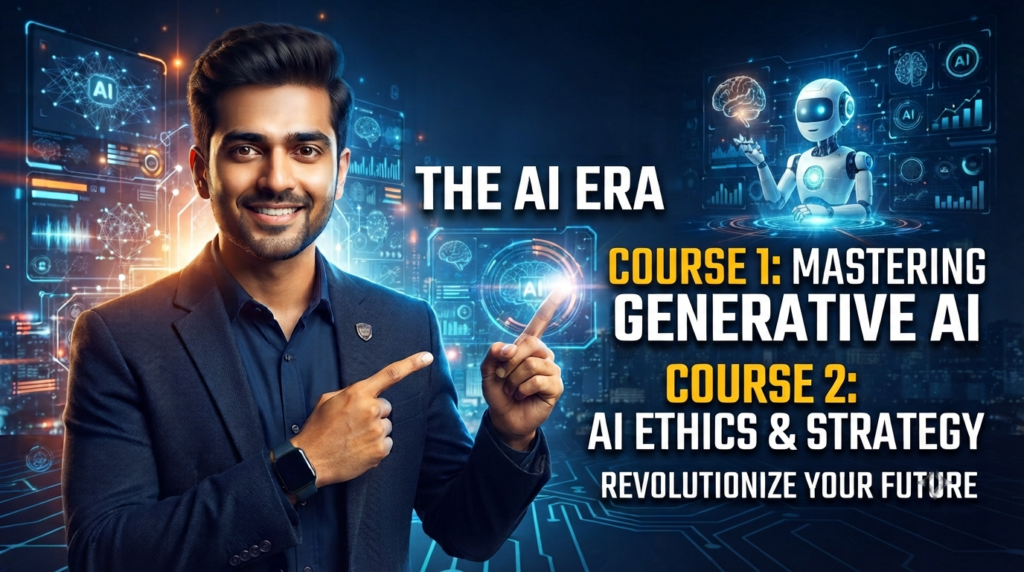
If you are looking for two courses to learn in the AI era, a strong starting combination is:
1. Generative AI and Prompt Engineering
Learn how to use AI effectively for research, productivity, content, problem-solving, and everyday digital work.
2. AI Automation and AI Agents
Learn how to connect AI with tools and workflows so that repetitive multi-step tasks can be handled more efficiently.
The combination is more useful than learning either subject in isolation.
AI will continue to evolve, so the most important skill is not memorizing one particular tool. It is learning how to understand new AI technologies, evaluate them, and apply them to real problems.
If you are starting today, focus on practical knowledge, build small projects, keep learning as the technology changes, and combine AI with a skill you already understand or want to develop.
That approach can make your learning journey more useful and future-ready in the rapidly changing AI era.